
There is a version of you, one that has been shaped by repetition, refinement, and accumulation of decisions about what works and what does not, that beauty has constructed over time. It is familiar, and because of that, it feels like truth.
But familiarity is not the same as access.
There is another version of you that exists prior to the mirror, small negotiations, and learned instinct to present yourself in a way that is legible to others. Most people do not encounter it directly, or if they do, it is only in passing, because reaching it requires an interruption that feels, at first, like a mistake.
It requires self-abandonment- a deliberate, almost clinical removal of aesthetic identity. We must dress without intention, stop checking the mirror, and resist the small, habitual gestures that reassure us we are “put together.” And then, in that stripped-down state, place yourself in relation to someone else to be useful, not for your own recognition.
What this produces is discomfort.
Without the familiar architecture of beauty reinforcing your sense of self, something begins to loosen. You may feel flatter, less defined, even slightly disoriented, as though a layer of recognition has been removed. There is a particular unease in realizing how much of your self-perception is mediated through reflection, feedback, and confirmation that you appear as you intend to appear.
When that confirmation disappears, so does stability.
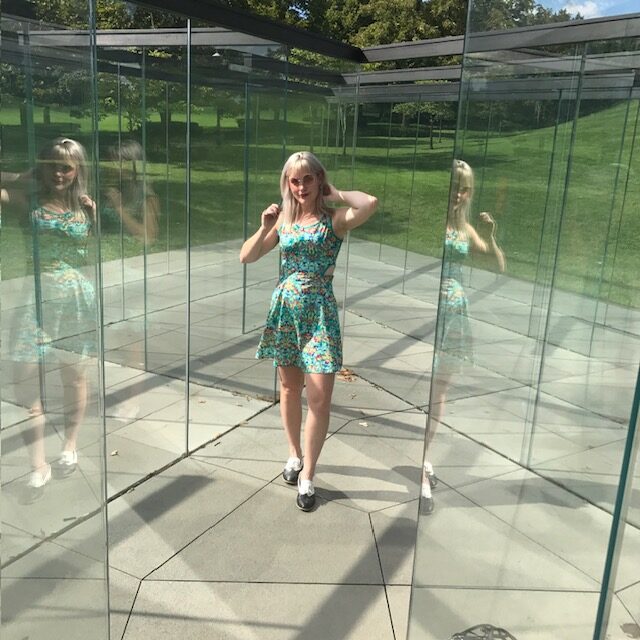
And what replaces it is disorientation, like moving through a labyrinth. You feel close, almost there, as if the next turn might return you to yourself. But the path keeps folding, subtly, convincingly, leading you through versions of yourself that nearly fit. Close enough for hope, but not home to settle.
This is the point at which most people instinctively return to themselves—reaching for the brush, outfit, or small corrections that restore a sense of control. But if you stay in that space just a little longer, something more interesting begins to happen. Deprived of aesthetic reinforcement, your awareness shifts. You begin to notice yourself sans image, and as a presence—how you move, attend, and relate when you are no longer organizing yourself around being seen.
In a culture that equates visibility with value, this can feel like a diminishment, even a kind of disappearance. But it is not an erasure. It is a clearing.
Because once you step outside of being visually defined, you start to detect what in you does not depend on that definition. There is a different precision that emerges—less about how you look, more about how you are oriented. And from that place, a subtle but important distinction begins to form: the difference between what feels like you, and what merely resembles something desirable.
This distinction is difficult to access without contrast.
Which is why self-abandonment, paradoxically, becomes a necessary part of self-recognition. You have to experience the absence of yourself—whether through overperformance or deliberate removal—in order to develop any sensitivity to it. Without that contrast, everything begins to blur. Beauty becomes habitual rather than intentional, and the line between expression and disguise quietly dissolves.
And so, when you return to beauty—and you inevitably do—the relationship is altered.
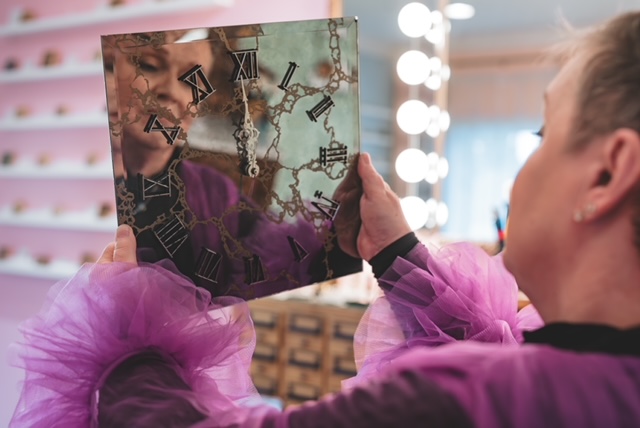
The mirror is no longer a site of discovery in the same way. It becomes interpretive rather than instructive, a place where something already felt is translated into form. You find yourself less interested in transformation and more attuned to alignment. Certain choices begin to feel excessive, others insufficient because they either distort or clarify something you have come to recognize more internally.
At the same time, something is lost.
The ease of disappearing into convention. The comfort of deferring to what is already established. The strange relief of not having to decide what is actually yours. To return with awareness is to take on a certain responsibility—to choose, repeatedly, whether you are using beauty to access yourself or to move away from yourself again.
Most people never quite arrive at this question. They remain within a cycle of refinement that feels productive but is, in many cases, a more sophisticated form of abandonment. But occasionally, someone interrupts that cycle. They step away—intentionally or not—and come back with a sharper sense of discernment, a lower tolerance for misalignment, and a desire not simply to look better, but to recognize themselves more clearly.
These are the people I tend to work with most closely.
Because what I offer is not just instruction in application, but a framework for perception—how to distinguish between what enhances your presence and what replaces it, how to recognize when something belongs to you and when it does not. This is not a skill that can be fully taught without experience; it has to be felt, tested, and, at times, lost.
Even the objects we attach meaning to seem to follow this pattern.
The vintage compacts I refurbish—each one tied to a specific place, a moment, a life—carry a history of separation. They were once held closely, used daily, part of someone’s ritual of self. And then, at some point, they were set down, passed on, or forgotten. They left one life entirely before they could enter another.
In that sense, their meaning is not diminished by abandonment—it is created through it.
They had to leave in order to return differently.
And perhaps the same is true for us.
Not that we should aim to abandon ourselves, but that we cannot avoid it entirely. The work is in learning to recognize when we have done so—and in developing the ability to come back with greater precision, carrying only what still feels like our own.
What no longer works once you’ve seen the difference?