I thought tending to my garden would bring clarity.
Instead, I met you.
Somewhere between pulling weeds and raking leaves, I must have brushed against your resin. I didn’t notice at the time. You’re not dramatic like that. You prefer stealth. You hitchhike quietly, transferring yourself to every opportunity of exposed skin during what I thought was a wholesome little date with nature.
You left with me.
I didn’t detect your presence then. You’re such a sneaky souvenir. While I rinsed my hands and went about my life, you were already making arrangements beneath my skin.
Days later, you introduced yourself.
First a small irritation in one spot, polite enough to ignore. Then, with the confidence of someone who knows they’ve already been invited inside, you began dropping pins across my body as if mapping new territory.
Apparently I didn’t rinse you off quickly enough.
You’re fascinating that way. Most injuries are honest. A burn declares itself instantly. A bruise blooms soon after impact.
But you prefer suspense.
You let a person move through the world comfortably for several days before unveiling the consequences of a moment they didn’t even know was happening.
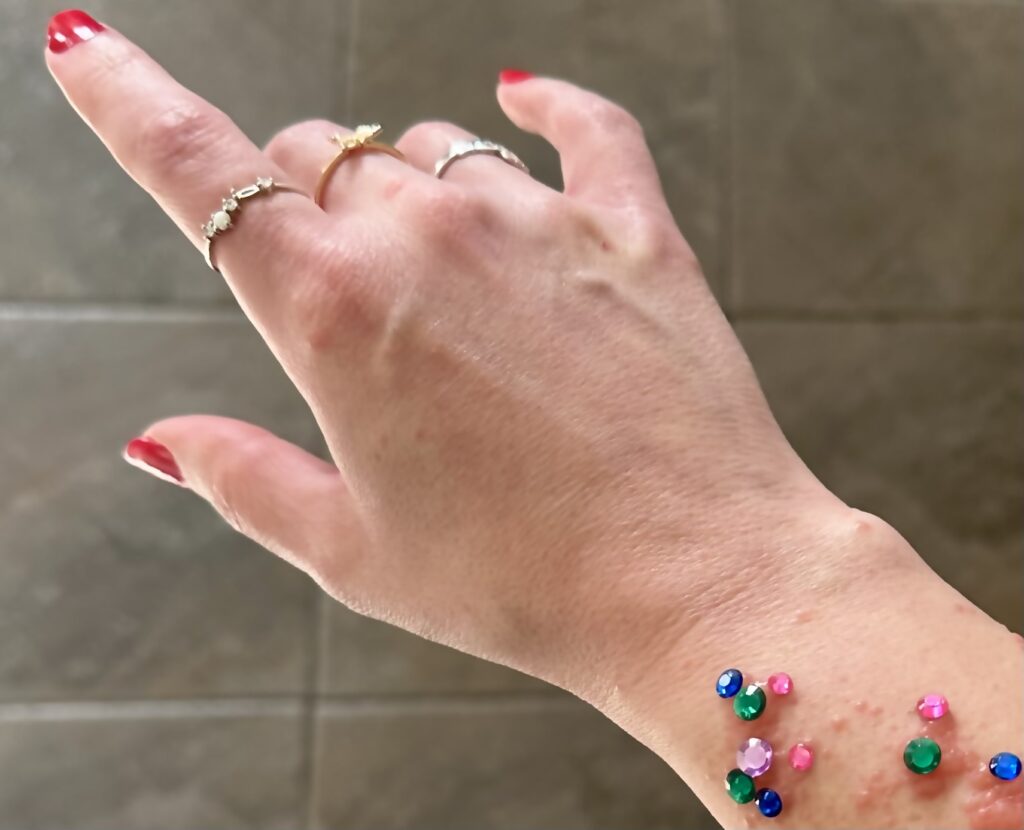
And once you do arrive, you are obsessed with texture.
In some places my skin feels like bubble wrap — tight, pressurized little domes waiting for the wrong kind of attention.
In other places it resembles Nerds clusters — tiny, granular constellations scattered across the surface.
Some patches swell like raspberries, soft and uneven, their little drupelets forming a strange botanical echo of the plant that started all of this.
And then there are the flatter areas, raised just enough that if someone closed their eyes and ran a finger across them they might think they were reading braille written directly onto my body.
You’ve turned my skin into a tactile language.
A code composed entirely of irritation.
So you’ve been teaching me things.
You’ve taught me about blinking rashes — the strange sensation of seeing my heartbeat pulsing through your red patches, as though my circulatory system has become an accomplice.
You’ve taught me about weeping — that blisters can cry from inflammation alone, little clear tears gathering at the surface.
You’ve taught me that giving myself goosebumps somehow feels like resistance, as if tightening the skin might discipline the chaos underneath.
And strangely, you’ve taught me curiosity.
Because as miserable as you are, I keep finding myself studying you like an amateur dermatologist. Watching how the redness migrates. How one patch fades while another ignites somewhere else. How the skin lifts and settles, lifts and settles, like weather patterns moving across a small, personal climate.
You’ve even taught me to dress differently. I’ve learned to hide you in certain places and reveal you in others. A strange styling exercise I never would have attempted otherwise.
And then, of course, you made your way to my face.
You must appreciate the irony.
I am a makeup artist. My profession is built on the belief that color, light, and texture can be negotiated with. That a brush and a thoughtful hand can bring harmony to the surface of the skin.
And yet there you were.
Bright, inflamed, and completely uninterested in my professional authority. I had a client that day. Standing in front of the mirror, I had to admit something that runs beneath the entire beauty industry. Makeup can cover color — temporarily. But inflamed skin is a moving target.
You shift shades beneath the surface like a mood ring. Pink to red to furious crimson, changing faster than any pigment I could place over you.
And texture? Texture is where the illusion collapses entirely. Makeup cannot remove texture. Makeup is texture.
So I told my client this truth. “This,” I said, lightly gesturing to the strange terrain of my face, “is about as good as my makeup can help this.” It felt oddly liberating to admit it. Even illusionists must occasionally step aside when the surface refuses negotiation.
But since you insisted on being seen, I decided I might as well collaborate with you.
If I couldn’t erase you, I could at least design around you.
At one point I placed rhinestones along the faint edges of your rash, emphasizing you while simultaneously disguising you — a little optical sleight of hand. Some of the larger patches resembled fireworks or lightning strikes across my skin, bright irregular bursts that refused symmetry.
So I leaned into the drama of it, tracing the edges in sparkle like a cartographer reluctantly mapping a storm.
You, Poison Ivy, accidentally became part of a beauty experiment.
Which is perhaps the most irritating compliment I can offer you.
Because while you are objectively miserable — itchy, inflamed, disruptive — you have forced a certain intimacy with my own skin that modern life rarely requires.
You’ve made me notice things.
The pulse beneath the surface.
The fragility of a barrier we normally assume is stable.
The absurd fact that a microscopic oil from an unremarkable vine can reorganize an entire week of someone’s life.
So here we are, you and I, in a relationship neither of us asked for.
And I find myself holding two sentiments at once.
Thank you, Poison Ivy. Thank you for reminding me that skin is not simply a canvas for beauty but a living boundary that occasionally revolts. Thank you for showing me where the illusion of control ends.
And also—
F. You, Poison Ivy. For the itching. For the blisters. For turning my morning routine into a dermatological hostage negotiation.
You are a terrible teacher. But I will admit something. You are an effective one.