There once was a floral scarf that was not, by any serious standard, impressive.
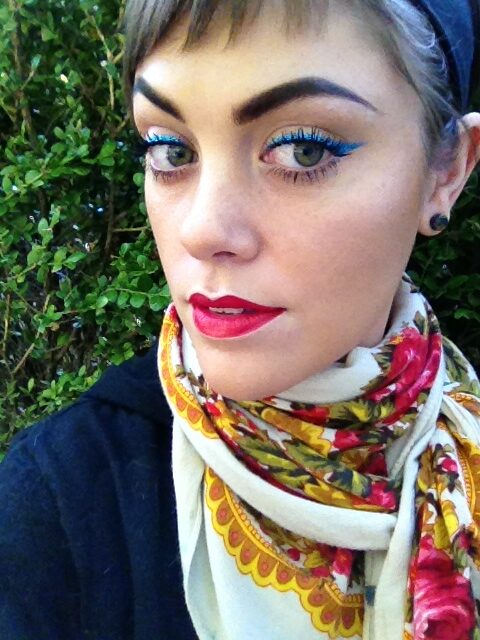
It did not gleam or whisper of inheritance or taste. It was cheerfully stubborn — magenta pinks, golden yellows, tender greens insisting on life even when the day did not. I wore it around my neck, tied it to bag handles, spread it over whatever metal or laminate surface I was assigned while working as a makeup artist in New York City. Others dressed their kits in black. I arrived with flowers.
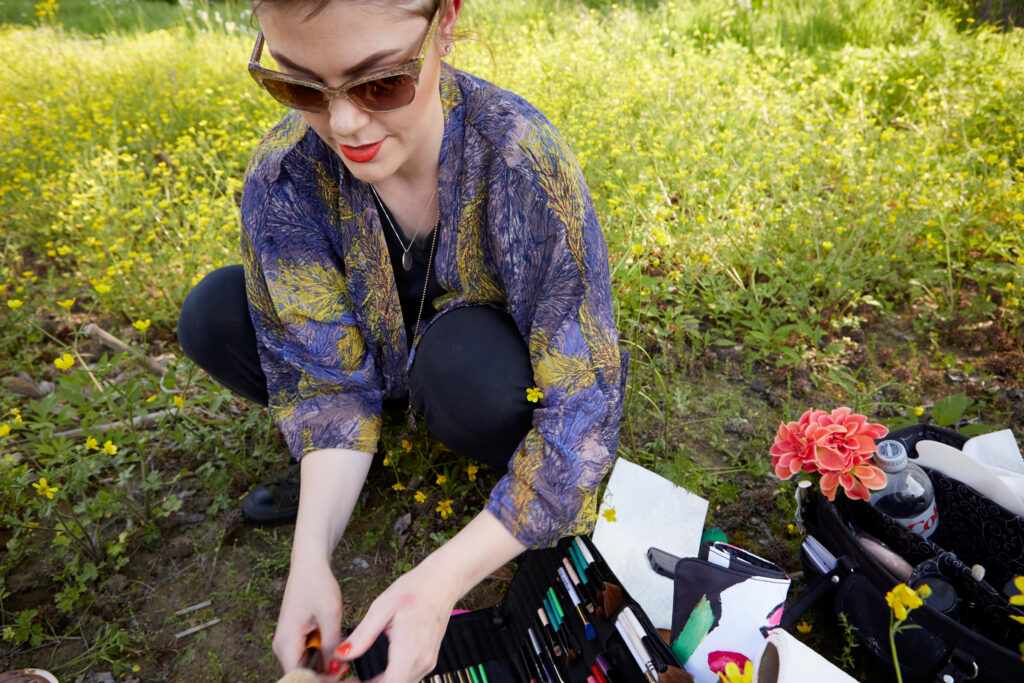
This was not merely metaphorical. On certain days, I packed a bud vase and a single bloom. I carried them on the subway with my full kit — up stairs, through turnstiles, across platforms. I felt a little like Mary Poppins because I was whimsical. I was smuggling enchantment into utilitarian spaces. To schlepp anything extra in New York City is a declaration. It means you have decided beauty is worth the literal burden through shoulder space and spinal effort. A trade: convenience for atmosphere.
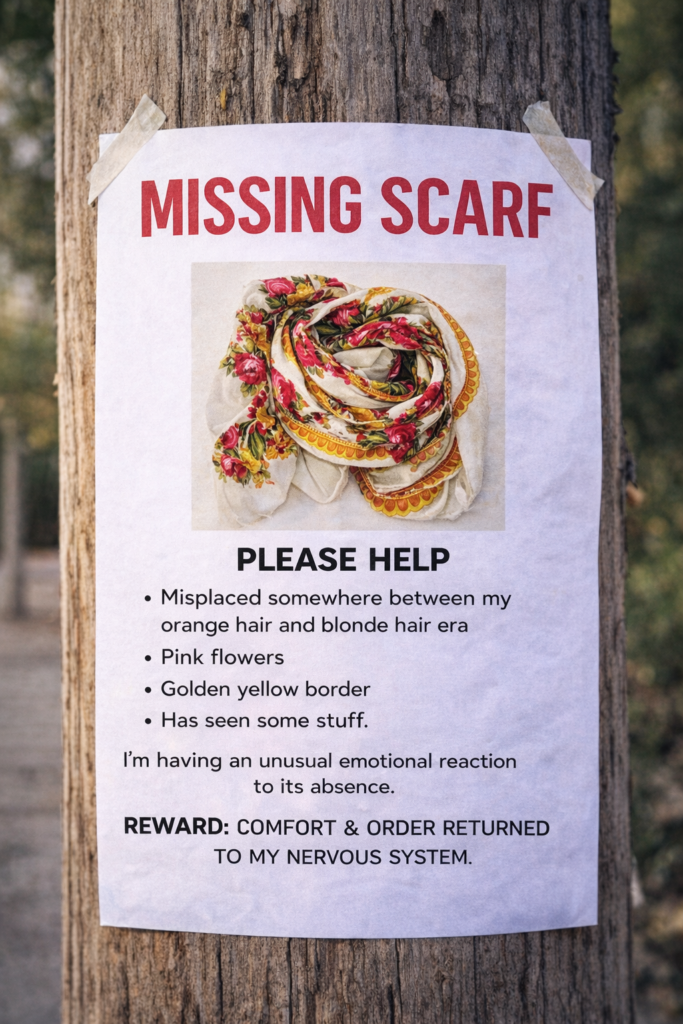
The scarf is now gone. I prefer the word misplaced to lost, though the body does not recognize the distinction. Its absence unsettles me disproportionately. I miss it not only as fabric but as regulation — the small signal of safety and coherence it offered. When something that has traveled so faithfully beside you disappears, it exposes an odd truth: you were leaning on it more than you knew.
In that growing realization, I found myself thinking of the song “The Place Where Lost Things Go.” Certain lyrical melodies articulate what we cannot quite bear to name — the idea that what is lost is not annihilated, only relocated. Folded somewhere beyond our immediate reach. The thought does not erase the absence, but it softens its edges. It allows for the possibility that love alters form rather than vanishing.
We are taught to categorize beauty as decorative — pleasant, optional, indulgent. Yet neuroscience suggests otherwise. In Your Brain on Art, Susan Magsamen and Ivy Ross describe aesthetic experience as biological. Color, pattern, texture, music — these alter physiology. Cortisol shifts, dopamine releases, and inflammation markers can decrease. Beauty is not merely pleasing. Beauty is regulatory.
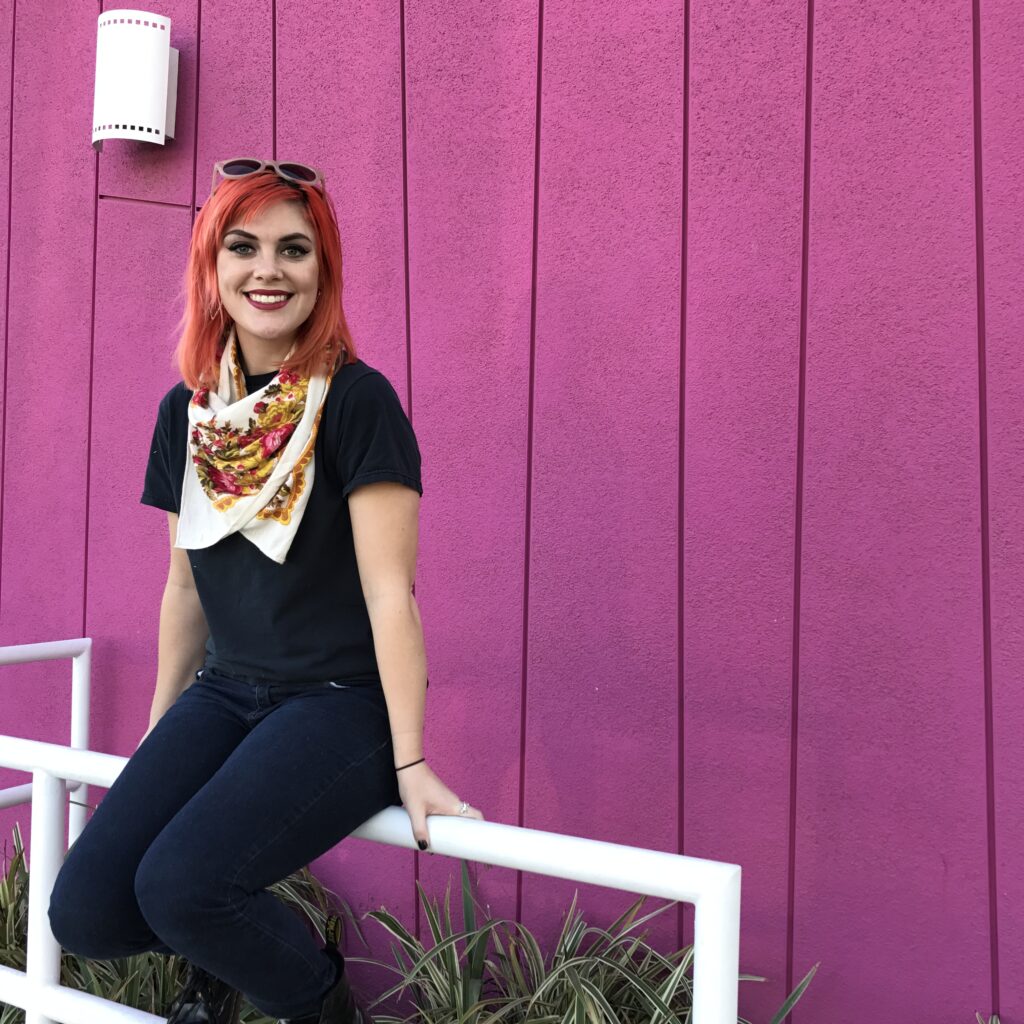
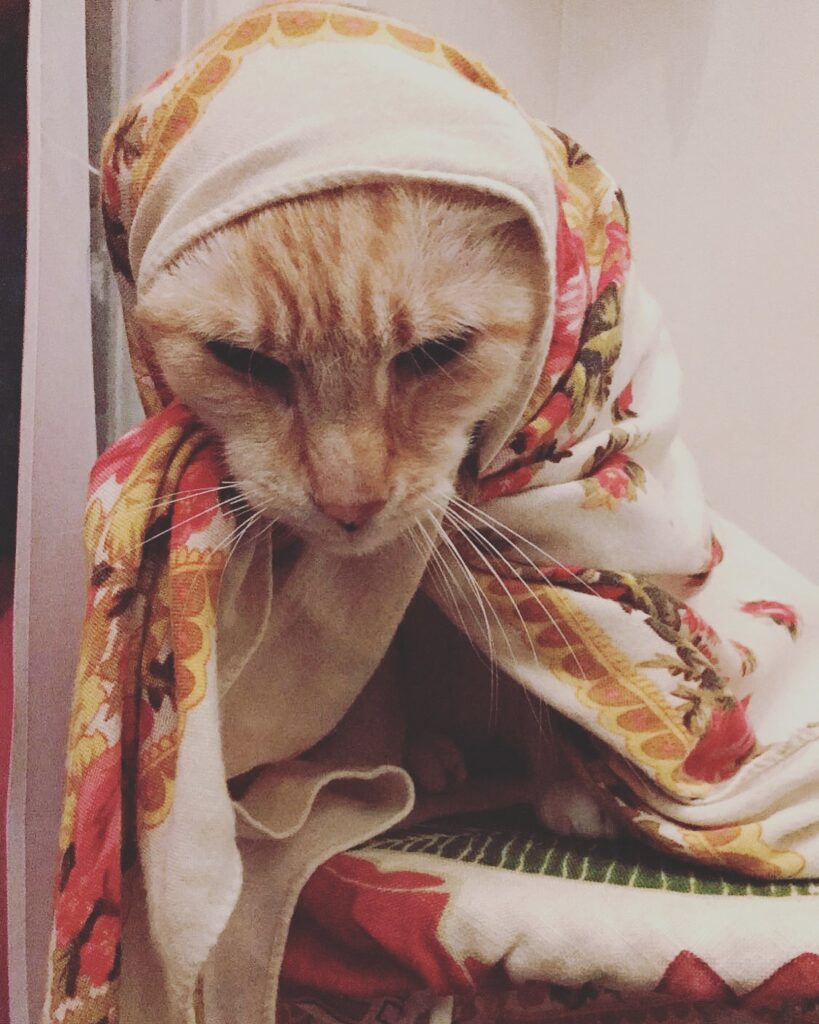
The brain is always scanning: Are we safe? Do we belong? Fluorescent glare, hard lines, vinyl chairs arranged for endurance rather than dignity — these are not neutral. They register as vigilance. Organic pattern and color variation whisper something older: health and life persists here.
When I laid that scarf across a folding table, I was not indulging whimsy. I was adjusting the emotional temperature of the room. I was trying to say, wordlessly: You are safe enough.
I feel this most acutely in medical spaces. The beige. The hum. The impersonality. Before any diagnosis is spoken, the nervous system has already braced.
Recently, before a medical appointment that unsettled me more than I expected, I sat down and painted a miniature piece of art. Small enough to fit in my palm. Acrylic at first — deliberate, controlled. Then a tear fell onto the surface and refused to be absorbed. The pigment loosened, bled outward, softened its own edges. Acrylic became watercolor. Or rather, tearcolor.
When it dried, I noticed something quietly astonishing: the same magentas, the same golden yellows, the same tender greens. The scarf’s palette had returned through my own body. What I thought I had lost had, in some way, been internalized.
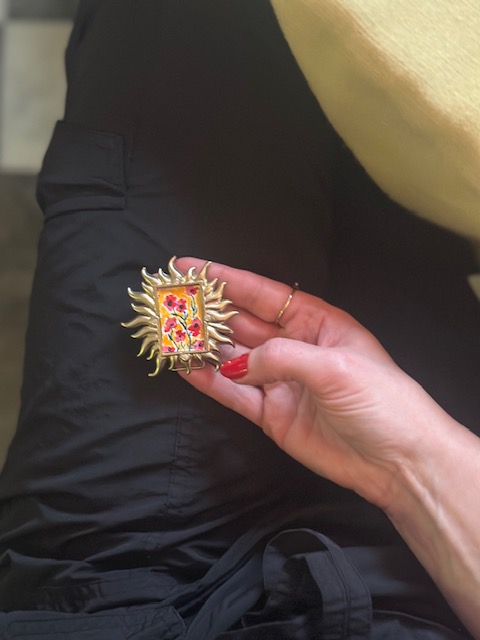
Perhaps this is what beauty does when we carry it long enough. It moves inward and becomes reflex.
Cosmetics always felt like this to me as well — blending shadow, arranging brushes, laying out color against the industrial geometry of a borrowed table. Each gesture was intention made tangible and a way of regulating myself and, perhaps, the person in front of me. It was are made visible.
The disappearance of the scarf has clarified something I might otherwise have ignored: I require beauty as sustenance. As ornament, yes, but as medicine. I need it in the way one needs warmth or rhythm. I need beauty for my biology.
We often speak of resilience as grit, endurance, and tolerance. But perhaps resilience is also arrangement. A scarf carried up subway stairs. A single flower in a bud vase. A miniature painting made before an appointment you do not want to attend. A tear that alters the medium and reveals the colors were inside you all along.
Lost things, if the song is right, are not destroyed. They are kept somewhere we cannot see — until we are ready to find them in another form. These are small acts. The brain, in its deep and ancient wisdom, does not think so.
Where to Explore Further
If this essay resonates — if you, too, have ever felt disproportionately steadied by color or undone by its absence — I can’t recommend Your Brain on Art enough. In it, Susan Magsamen and Ivy Ross articulate what many of us have sensed intuitively: beauty is not indulgence, but biology.
And if you’re local, consider purchasing it from the gift shop at The National Quilt Museum — thoughtfully curated by buyer Meghan Brown, whose eye for meaningful objects feels like an extension of the book’s thesis itself. There is something powerful about acquiring a book on the neuroscience of beauty from a space devoted to textile, color, and human hands. It turns reading into participation.