
We live in a world saturated with language — not just in books or conversations, but on shirts, coffee mugs, doormats, kitchen signs, and checkout displays. Everywhere we go, words are waiting for us. They linger in little quips, “cute” sayings, and clever jokes. They seem harmless on the surface. But those words, repeated through décor and daily use, become the atmosphere we live in.
This week, two examples stopped me mid-stride.
One was printed on a home décor sign:
“I am at the age that makeup is no longer optional.”
The other appeared on a t-shirt, displayed proudly on a rack:
“It’s better to be late than arrive ugly.”
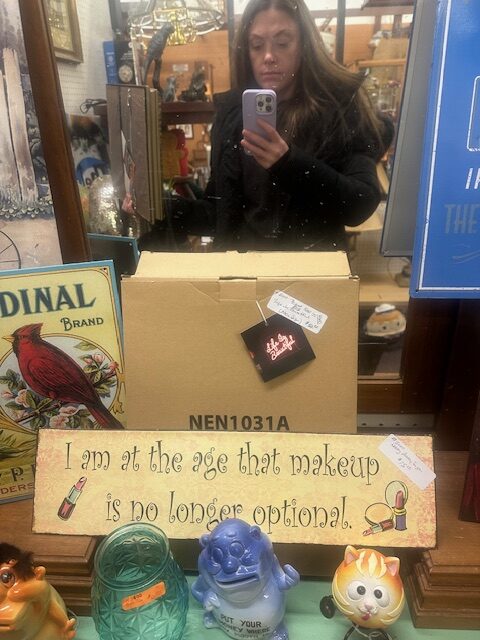
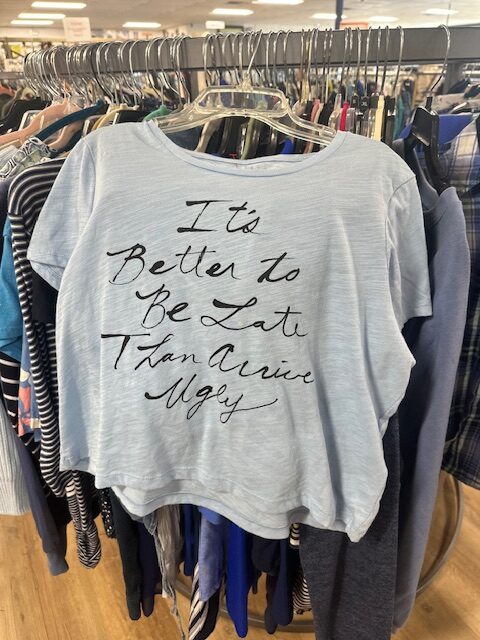
At first glance, these are meant to be funny, lighthearted, and relatable. The sort of thing you might laugh at with a friend and keep moving. But underneath the humor, something tightens. Because these aren’t just jokes — they’re tiny cultural instructions dressed as amusement. And they whisper things we’ve been taught to accept without question: that aging must be hidden, that we owe beauty to the world, that our worth rises and falls on how polished we appear.
Where humor tries to help and where it begins to harm
There is a place for humor, especially when we’re in a low emotional state. A joke can be a buoy — lifting us from heaviness into something brighter, more breathable. Humor can be a bridge out of worry or shame.
But something becomes distorted when humor that once soothed us is printed onto merchandise, packaged, and sold. What begins as an emotional coping mechanism becomes a long-term belief system once it finds its way onto a sign or t-shirt.
And then people purchase it.
Bring it into their homes.
Wear it into their communities.
Display it in their personal environments.
This is where the joke shifts from momentary relief to something more potent.
Because buying a message is not passive — it’s an endorsement.
When we exchange money for a slogan, we’re not just amused by the words; we are agreeing with them. We’re saying, “Yes, this reflects something true enough about me or the world that I want it displayed. I want it to represent something about how I move through life.”
A $15 sign becomes a quiet declaration.
A $2 t-shirt becomes a belief we’re willing to wear on our skin.
Endorsement turns the joke into something far more consequential — a personal and public statement that this messaging belongs in our sphere of influence.
And that’s where the tension sharpens.
The silent conditioning behind the humor
Beneath the laughter, these messages normalize a worldview:
- Aging should be corrected.
- Showing up “unpolished” is a mistake.
- Beauty is an obligation, not a choice.
- Your natural face is inadequate without cosmetic intervention.
- Self-criticism is endearing if it’s funny enough.
The delivery is humorous, but humor doesn’t neutralize harm — it often disguises it, making it easier to adopt without resistance.
Humor that becomes home
Once placed on a wall or worn repeatedly, the phrase becomes part of someone’s daily landscape. The repetition matters. The words soak in. They settle. They become the air around us and the vocabulary inside us.
And from that point, the message is not simply “out there.”
It’s in here, shaping how we think about ourselves, our faces, our aging, our value.
Does this messaging expand us… or shrink us?
Makeup, at its best, is art. Play. Ritual. Expression. A deliberate form of creation.
But when it is framed as “optional no longer,” the artistry disappears, and we are left with duty. Obligation. Compliance.
When beauty becomes something we “must” maintain, it stops being empowering. It becomes a performance we owe to the world.
Rewriting the spells we choose
If words are wands — and they absolutely are — then we must choose spells that honor our humanity rather than tighten around it.
Imagine merchandise that said:
- “Beauty is a choice, not a chore.”
- “Your arrival matters more than your appearance.”
- “Makeup is expression, not obligation.”
- “You are allowed to show up exactly as you are.”
These would be endorsements worth making — messages that expand us rather than compress us.
A gentle provocation
Next time you encounter a sign or shirt about beauty, pause for just a moment. Ask yourself:
- Does this message uplift me… or restrict me?
- Is this humor… or is it a quiet demand dressed in laughter?
- If I buy this, what am I endorsing?
- Does this belong in the same space where I live, work, and breathe?
- Would I choose to tell someone I love this same message?
Because the environment we build around ourselves matters.
It guides our thoughts. It shapes our norms.
It even influences how kindly we treat our own reflection.
And we deserve words that reflect our worth, not words that quietly ask us to earn it.