
Five years in business. Fifty years old. Ten years married. And suddenly, everything feels up for review. And so you begin to look back.
In a marriage, that reflection can be shared—memories negotiated, softened, corrected by another voice. No, it didn’t happen quite like that. There is relief in that friction. A sense that the story doesn’t belong entirely to you.
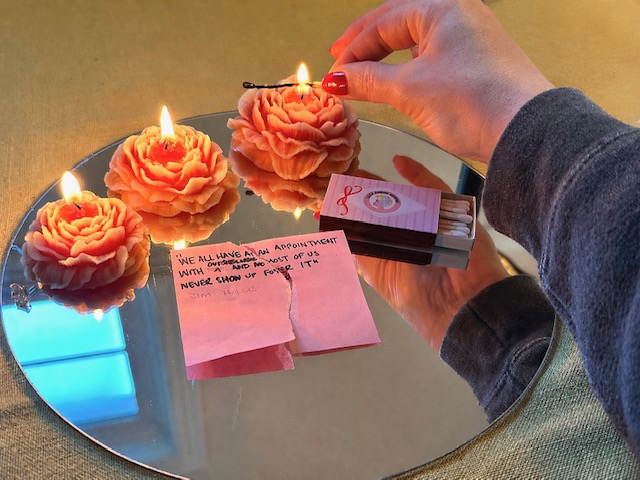
But in a one-person business, the reflection folds inward. You are the one who began it and the one who must now evaluate it. The one who once moved forward with conviction—and the one who now, standing years later, is no longer sure what that conviction meant.
The dialogue becomes internal. Was I right to start this? Did I misunderstand my own ambition? Is this still mine to carry? There is no one to answer you but yourself.
And to want to leave—to even entertain the possibility—is a strange and delicate fracture. Because you are not just walking away from a business. You are stepping away from a version of yourself. The one who believed, who insisted, who stayed. You are, in a way, both the one leaving and the one being left.
Certain moments light up: the beginning, especially. The clarity of the idea, early energy, and the feeling that something meaningful had chosen you. You remember yourself as decisive, the path as intentional, and the direction as somehow…obvious.
But what you are seeing is not the storm. It is heat lightning. A distant illumination of the shape of what was, but you do not hear the noise it carried. The doubt, the hesitation, the contradictions that existed alongside the certainty.
Memory has a way of editing those out.
I was reminded of this while watching Heat Lightning at Market House Theatre—a production that lingers with questions. It begins with a premise that feels almost playful: on his 50th birthday, a man is thrown back into a night from his past, surrounded by old lovers, younger selves and unresolved tensions. He has not been remembering falsely, exactly—but partially. And so have we.
When we reach these points—five years in, ten years in, fifty years lived—we are not comparing our present to the past as it was. We are comparing it to the past as it appears now, from a distance, stripped of its full emotional weather.
We remember the conviction more clearly than the confusion, beginnings more vividly than the uncertainty that surrounded it, and intention more than the improvisation.
And then we judge ourselves accordingly.
We wonder why the business feels different than we thought it would. Why the marriage doesn’t resemble its early intensity. Why we, somehow, feel less certain than the person we remember being.
But what if that certainty was never as complete as it now appears?
What if you were always improvising, just without the awareness that comes from looking back? Because if the past is only ever visible in flashes, then the story you’ve been using to measure yourself was never the full picture. It was an interpretation. A necessary one, perhaps—but not a definitive one.
So when you stand at the milestone, asking whether to continue, whether to change, whether to let something go—the question may not be whether you have stayed true to the original vision. It may be whether you are willing to see that the original vision was never fixed. That it, too, was in motion.
You are not betraying your past self by questioning what you built. You are continuing the conversation they started, only now with more context and awareness, and perhaps less illusion.
The storm was never silent. You were simply too far away to hear it in retrospect.
And maybe growing older—whether in years, in love, or in the life of something you built alone—is to recognize it for what it is: real, beautiful, persuasive and incomplete.
(If you have the chance, I would genuinely recommend seeing Heat Lightning at Market House Theatre. It’s one of those stories that rearranges you.)