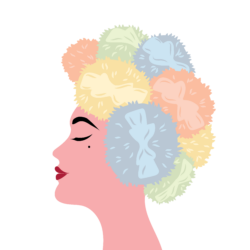
Traditional artists are trained to study light, form, and contrast—to pay attention to the curve of a jaw, the hollow of a cheekbone, the way warmth and shadow play across a subject. They spend years perfecting how to render a face on paper or canvas. But something changes when the medium isn’t charcoal or oil—when it’s cream blush, highlighter, or eyeliner—and the surface isn’t a model or muse, but their own reflection.
For many, this is where the resistance begins.
It’s one thing to observe a face. It’s another to become the face being observed.
When traditional artists try applying makeup on themselves, they often feel a strange dissonance. It can feel performative. Uncomfortable. Almost like trespassing into a world where beauty is worn, not just created. Suddenly the brush feels heavier. The colors feel louder. The act feels more exposed than expressive.
But put that same artist in front of someone else’s face, and a different energy emerges. They return to familiar instincts—attention to undertone, a love for symmetry, curiosity about structure. The face becomes a landscape again, but this time it’s warm, blinking, alive. And what they’re creating isn’t just visual—it’s relational.
Traditional artists often flourish when doing makeup on others because it mirrors what they already know: how to see. But makeup adds new dimensions: how to touch gently, how to translate identity, how to stop before you’ve done too much.
When working on themselves, they may struggle because the act becomes personal. It activates insecurities, vanity, self-awareness. The makeup stops being an experiment and starts feeling like a statement.
But on someone else, the pressure softens because it becomes a collaboration. A moment of creative service and a reminder that beauty can be both crafted and shared, and that the face is not just a surface but a kind of living conversation.
This is why I rarely see traditional artists in makeup classes, and yet, when I do, they have an immediate advantage. Their sense of detail is already refined. Their language of color is fluent. But what they often haven’t explored is the emotional intimacy of using their own face as canvas. Or the humility of trusting someone else’s.
There’s art in that, too.
So if you’re a painter, a sculptor, a printmaker—consider this: What might you learn by applying pigment not just to the world, but to your own cheekbone? What might it stir to let your hands shape someone else’s idea of themselves for a day?
Your brush already knows what to do.
The face just asks a different kind of question.