
For a long time, I knew Norman Rockwell only as a cultural shorthand. His name seemed to stand for a particular idea of America: tidy, reassuring, faintly moral. His name had reached me, improbably, through Lana Del Rey’s album Norman Fucking Rockwell!, whose opening track bears the same title, but I had never felt the need to look closely.
The need arrived in an antique mall. There, among the chipped furniture and unlabeled curiosities, I found a decorative plate bearing one of Rockwell’s images. It was not meant for eating. It existed only to be hung, admired, and kept clean. This struck me as odd. Why take a moment from an ordinary life and preserve it so carefully? What kind of looking did this image, available only on a plate, ask of me?
Curiosity, once activated, is difficult to restrain. The plate led me to the paintings, and the paintings led me into areas I recognized immediately: bathrooms, bedrooms and vanity stations. These rooms are stages for both learning and trespass. Some stand before mirrors, practicing gestures of beauty and selfhood; others enter quietly or carelessly, exploring spaces not their own. Mirrors, vanities, and diaries silently witness moments of anticipation, rehearsal, and mischief alike.
What began to emerge was a different understanding of Rockwell. He was not painting confidence or nostalgia so much as the unique curiosity that they involved. Beauty, in his hands, was not a possession. It was an attentive, private, and often interrupted activity.
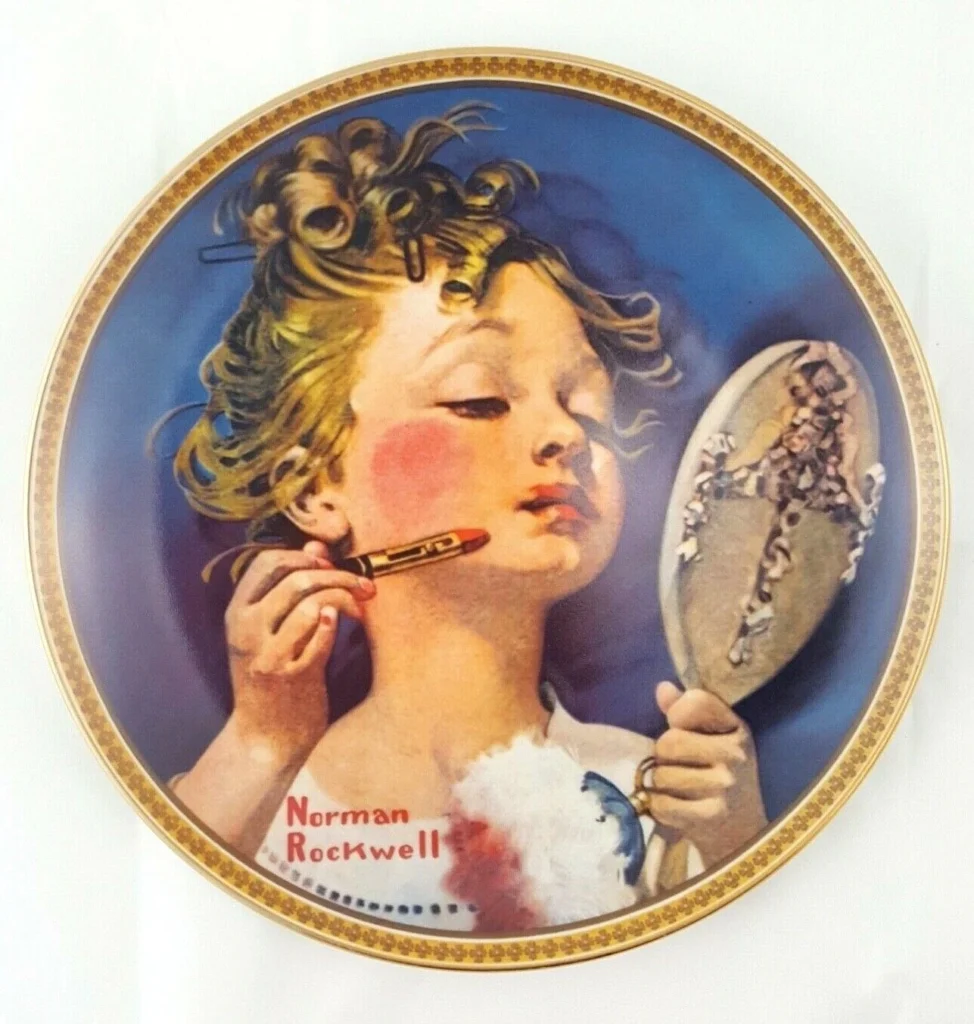
Making Believe at the Mirror
In Making Believe at the Mirror, a little girl stands before her reflection, experimenting with the idea of herself. The title is permissive and kind. This is imagination. She is not yet trying to be beautiful so much as trying to believe that beauty might be something she could enter.
The evidence is everywhere. Her hair is wild, barely contained, pins still doing their clumsy work. She grips the mirror tightly and holds it close to her face, as if proximity could conjure beauty. The lipstick strays far beyond the natural boundary of her lips, not in error so much as in enthusiasm. The blush puff is overloaded, boldly declared on her cheeks. Subtlety—the great adult achievement—has not yet arrived.
And yet her pinky finger extends delicately as she applies the lipstick. Somewhere, somehow, she has absorbed an idea of sophistication. She may not know how beauty works, but she knows how it behaves. The gesture is borrowed, slightly absurd, and deeply touching. Rockwell is not mocking her. He is preserving a moment before correction arrives, before restraint is mistaken for refinement.
This is a rare freedom: beauty without shame, beauty without audience, beauty before subtlety.
Girl at Mirror
In Girl at Mirror, the scene is one of negotiation. The mirror rests on the floor, propped against a chair that holds no one—its support improvisational, like the entire setup. A doll lies fallen beside her, neglected, a silent witness to attention redirected. In her lap, a magazine displays a photograph of a grown actress. The adolescent girl inhabits a living, full-color viewfinder, her body craned and curled to fit the mirror, while the actress remains a static, black-and-white headshot. Two entirely different perspectives confront one another: one requires movement, adjustment, and negotiation; the other asks only comparison and aspiration.
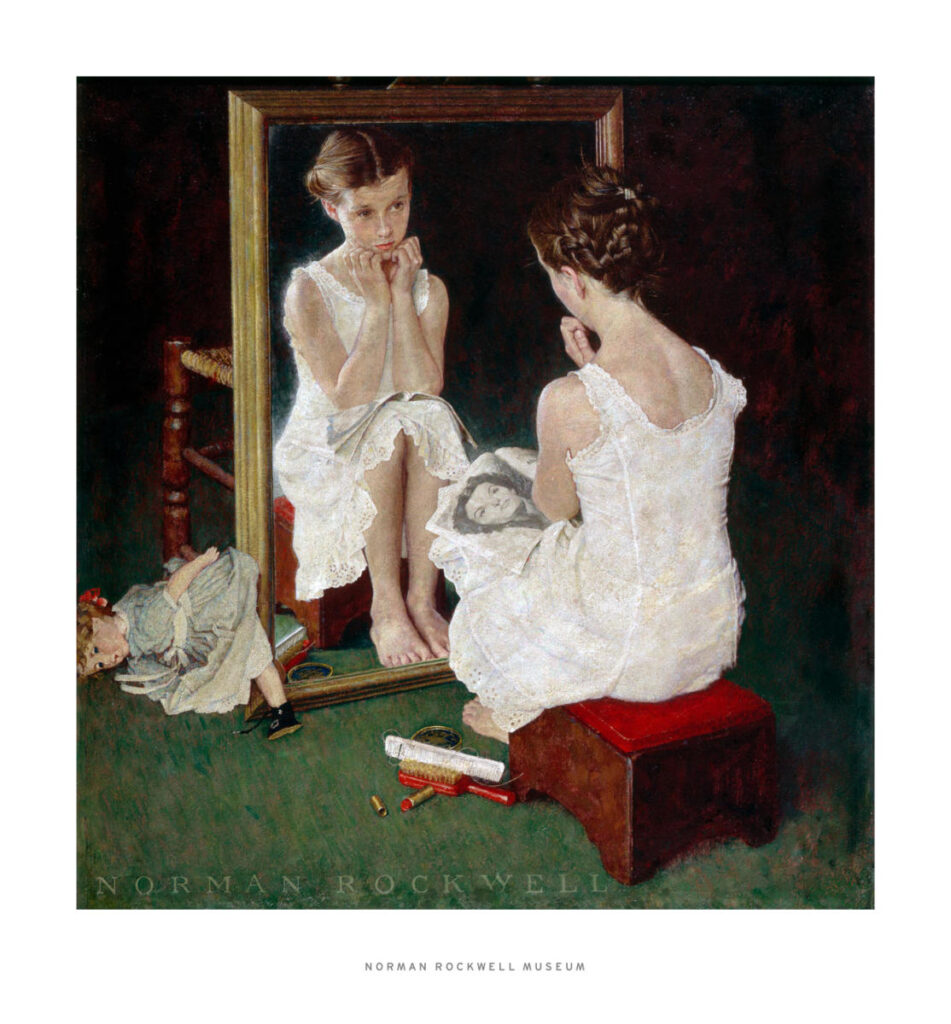
She does not simply look at her face; she measures her whole body against an ideal she cannot yet inhabit, negotiating every angle, every gesture. Beauty, here, is not effortless—it is rehearsed, awkward, and intensely private, a lesson in attention more than in accomplishment.
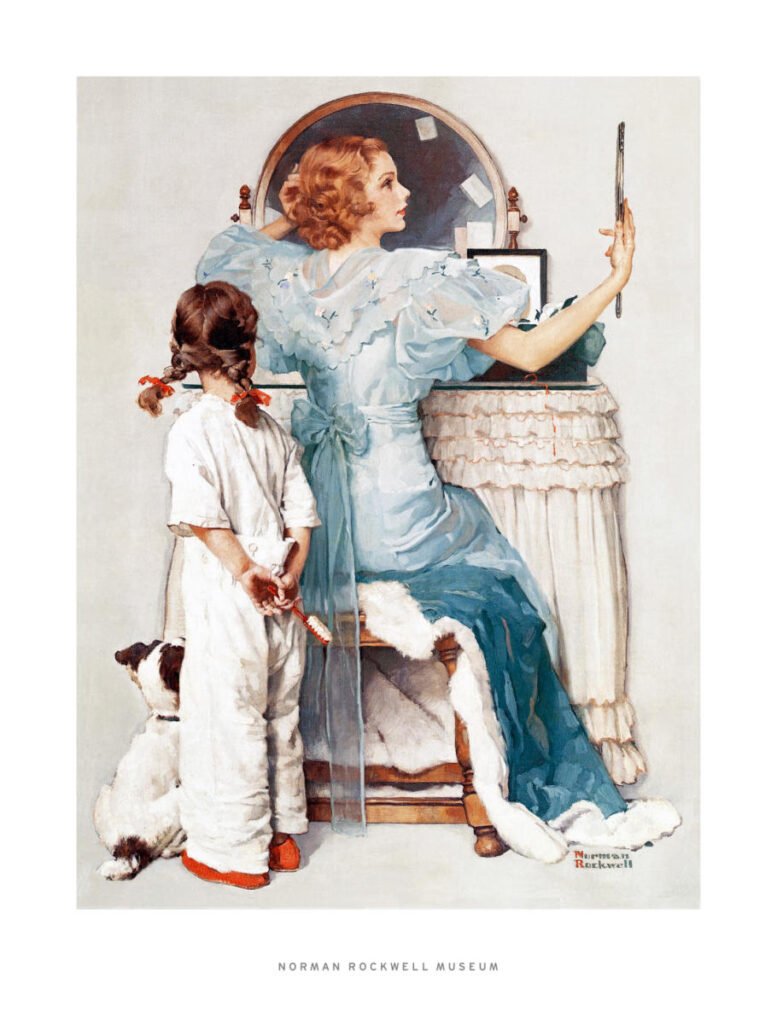
Going Out
By Going Out, beauty has become social. A young woman prepares for an evening beyond the home. She sits before a large vanity mirror and yet still reaches for a handheld one. Why the duplication? Is she seeking better light? A more flattering angle? Or has no single reflection become sufficient?
Behind her, the little sister watches. But what is she watching exactly—the technique, the transformation, or the possibility that she too will one day sit here? Even the dog is present, positioned differently, angled at yet another height. No one acknowledges the others. Rockwell arranges a quiet hierarchy of attention: self-assessment, aspiration, and loyal observation. Beauty now has witnesses, but it remains essentially solitary.
The Plumbers
It is precisely the presence of outsiders in these rooms that draws our attention. In The Plumbers, two men linger in a vanity area not meant for them, a space they likely had to pass through to do their work, now taken as a brief threshold, a pit stop for amusement. Their clothing is dirty; the room is pristine. They handle the cosmetics of an absent woman, treating beauty as novelty rather than ritual. One sprays perfume directly into another man’s face, entirely misunderstanding its purpose. For all their proximity to the mirror, their reflections are curiously absent—present, but unseen.
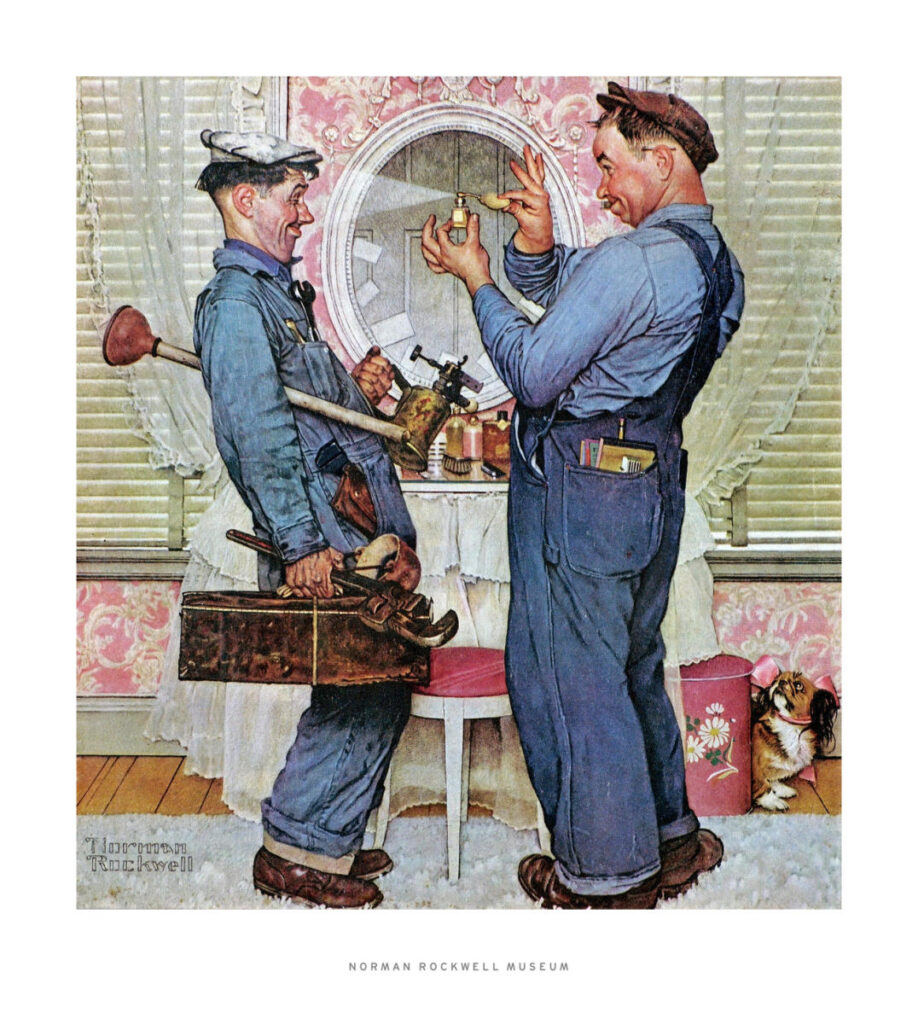
Even the dog bears witness, though not out of curiosity. Wearing a pink bow and far cleaner than the plumbers, it seems bewildered, an extension of the woman who belongs here, caught between order and intrusion, dignity and chaos.
Secrets (Boy Reading Sister’s Diary)
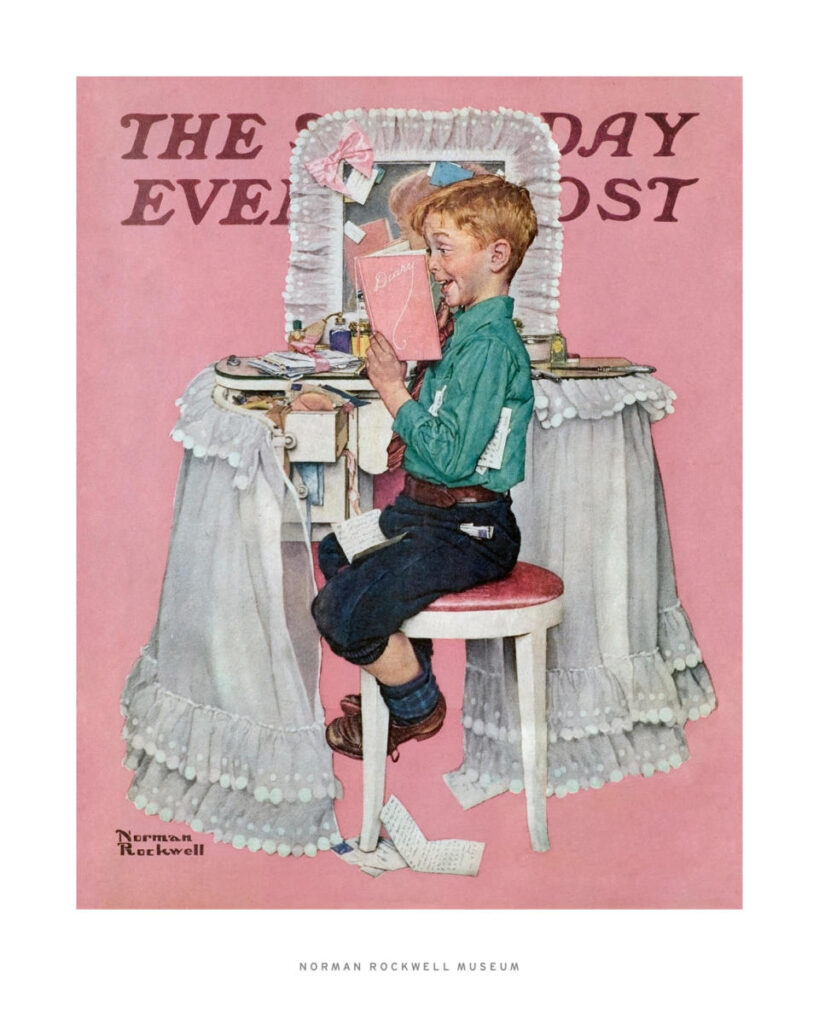
In Secrets (Boy Reading Sister’s Diary), the trespass is quieter, perhaps softened by youth. A boy sits at his sister’s vanity table, reading her diary and laughing. The surface is messy—cosmetics scattered, drawers left open. Did he create this disorder to reach the diary, or did he simply take advantage of it? Or is the mess itself a sign of something else: a girl who does not yet fully know who she is, still sorting through thoughts and selves, leaving her private world temporarily undone?
The diary sits among objects of beautification, and the pairing feels deliberate. Both are acts of purification. Both are ways of practicing the self in private. And yet the boy treats her words lightly, without care or consequence. Beneath the leg of the stool he sits on, a letter is partially crushed, held down by his weight. Another private thought, literally ignored.
What is harder to see—but harder still to dismiss—is what happens to him after this moment. Having read her thoughts, can he unknow them? Does this knowledge alter how he looks at her, or how he understands interior life itself? Rockwell leaves us here, in the uneasy aftermath, reminding us that curiosity is rarely neutral. Some forms of access change us, whether or not we acknowledge the cost.
Reflection
I come to these images as someone who spends a great deal of time noticing beauty—how it is learned, rehearsed, and occasionally mishandled. What draws me to Rockwell is not the polish of his scenes, but their hesitations. He stays with beauty while it is still unsure of itself.
As a scout and a purveyor, I am trained to recognize what captures attention. Rockwell reminds me to look just before that moment: when a gesture is too much, a mirror too small, an effort still visible. These are the beginnings we usually rush past.
Perhaps this is why these images linger. They understand that beauty is not a conclusion, but a practice—private, imperfect, and easily interrupted. And that, quietly, is where it becomes most human.