
One of the least acknowledged forms of generosity is beauty made by ordinary people on ordinary days. These acts are rarely profitable. Often they are not even consciously acknowledged. Yet they deeply nourish something.
Lately, it feels as though beauty has become one of the first things we are willing to sacrifice. Budgets tighten. Corners are cut. Buildings are erected quickly and cheaply. Public spaces become increasingly functional. Materials cheapen. Objects become more disposable.
Efficiency triumphs. Beauty is asked to justify its existence. And because beauty has always struggled to explain itself in practical terms, it is often the first thing escorted out the door.
Yet something curious happens when beauty disappears. People begin to hunger for it.
A longing for color in places dominated by gray, for craftsmanship in a world of convenience, for rooms, clothes, writing, faces, and objects that seem touched by care.
Many people move through their days aesthetically underfed. Then, unexpectedly, they encounter someone who has refused to surrender. Examples include:
- A woman whose makeup looks less like a cosmetic routine and more like a painter’s signature.
- A stranger whose clothing possesses a sense of composition.
- A home glowing warmly through an evening window.
- A paragraph so beautifully written on stationary that it slows the pulse.
And for a moment, the world feels larger than necessity. We speak often about art while overlooking how many artists exist outside institutions.
The person who dresses with imagination.
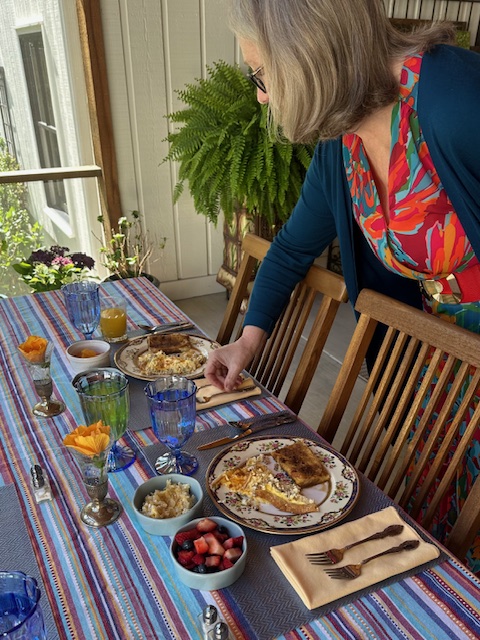
The friend who sets a beautiful table despite having few or zero guests.
The writer who labors over words few people may ever read.
The woman who treats her face not as a problem to be corrected but as a canvas on which to create something joyful.
None of these people are likely to be paid directly for their efforts.
Yet all of them contribute something increasingly rare. They remind us that life is more than logistics. Human beings require more than function. Utility alone has never been enough.
What they create may last only a day. A lipstick fades. Flowers wilt. An outfit is returned to the wardrobe. Evening falls and the lamp-lit room disappears behind drawn curtains.
But perhaps that is what makes these gestures so moving.
They are offerings. Small acts of resistance against drabness. Unnecessary in the way poetry is unnecessary. Unnecessary in the way sunlight across a wooden floor is unnecessary. And yet, somehow, essential. There are people among us creating beauty every day with no audience, no commission, and no guarantee that anyone will notice.
The least we can do is acknowledge them. The most we can do is join them.
To make something lovely.
To adorn a corner of the world. T
o become, however briefly, a feast for eyes that have gone too long without one.