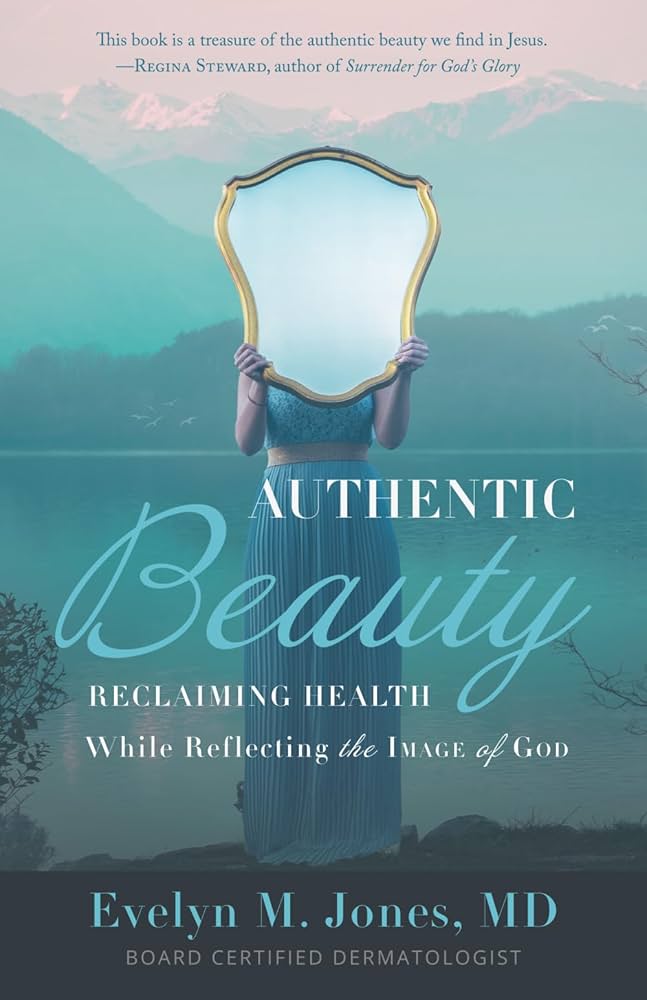
I came across Dr. Evelyn M. Jones’ book Authentic Beauty: Reclaiming Health While Reflecting the Image of God in a local magazine—Paducah Life, a publication lovingly devoted to the careful assembly of words in a distracted age. There was nothing urgent about the moment. No expectation that this encounter would matter. And yet, as is often the case with meaningful ideas, recognition arrived before explanation.
It was the cover that caused me to pause. A woman holds a mirror outward, not toward herself, but toward the world. The mirror is empty, holding nothing of the subject, yet it seems to wait patiently for the viewer’s own vision. The gesture is calm, almost ceremonial. In that instant, I felt a subtle recognition—as though the idea had been hovering, waiting not for a single observer, but for anyone attuned enough to perceive it—and that somehow, it had found both of us.
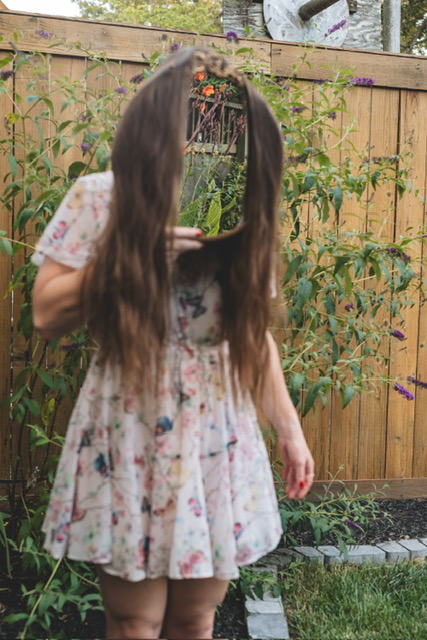
The previous summer, I explored a related visual impulse in a photograph for my own work, with the help of a photographer friend. I was the model, standing in a garden—a space both literal and metaphorical, tended carefully yet alive with surprise. My hair draped across the mirror’s surface, softening it almost into a mask, while the reflection of the world appeared within the frame. We did not know of Dr. Jones’ book then, just as she could not have known of our book project. No one borrowed from anyone else. Instead, something synchronistic occurred. The same creative fuse was lit in two different places at roughly the same time—each responding to a shared instinct about attention, care, and the way beauty turns outward.
There is a certain comfort in this kind of coincidence. It suggests that our private preoccupations are not as private as we imagine. That ideas circulate, waiting for receptive minds. That when enough people begin to sense the same imbalance, the same hunger, similar images emerge to give shape to it.
Dr. Jones is a dermatologist here in Paducah—a physician by training, precise by necessity. My own path into the beauty world was less clinical: makeup school, fashion studies, objects, images, noticing. We entered through different doors. And yet, as I read her book, I felt a growing sense that we were standing in the same room.
Her writing insists, gently but firmly, that beauty cannot be built on neglect. That health is not an aesthetic trend but a prerequisite. Food, she reminds us, is not merely fuel or indulgence, but an elixir—one that, if chosen with care, can restore far more than we tend to expect. Many of the concerns people bring to the beauty industry, she suggests, are not problems to be concealed, but messages to be listened to.
This idea, that care must come before adornment, has long been my own quiet conviction. Aesthetics matter. They delight, allow us to explore, to embody, and to play. And yet, when approached thoughtfully, a single detail of adornment can act as a talisman, quietly reinforcing and celebrating the care already in place. But if asked to do the work of foundations, beauty fails us. Frantic and unmoored, consumption replaces curiosity. We decorate what has not been tended. When care and adornment move in dialogue, however, they invite a richer, more attentive way of being.
To tend anything well requires time. And time, in our culture, is increasingly scarce.
At one point in the book, Dr. Jones includes a line from John Ortberg about the danger of skimming our lives rather than living them. The sentence names something many of us feel but struggle to articulate: that the great threat to our well-being is not collapse, but distraction.
It was this realization—arriving slowly, over years—that led me to step away from social media. I did not leave out of disdain, but out of a desire to recover attention. To move at the pace required for discernment.
Noticing, I’ve come to believe, is not a luxury. It is how we return to ourselves.
In this way, Dr. Jones and I approach beauty from opposite directions, yet arrive at similar conclusions. Her work moves upward from the body—clinical observation, physical health, the measurable foundations of care. Mine often begins at the surface, with objects and images, and digs downward, asking what can be safely added only once something deeper is already in place. She establishes the ground; I explore the cherry on top. Somewhere in the middle, we meet.
I am currently writing my own book—still forming. It will rely on images as much as words, and it will likely hold more tension than answers. But reading Authentic Beauty reminded me that meaningful work does not require uniformity of belief or method. It requires sincerity, patience, and willingness to resist the shortcuts of our industry.
There is something so reassuring about discovering that another person, working locally, shaped by a different education and a different vocabulary, from a different generation, has been noticing the same things and is willing to talk about them. That we are not alone in our insistence that beauty, to be sustainable, must be rooted in care, that it can be both attentive and playful, foundational and adorned.
For that insistence—for the steadiness of her voice, and for the courage to write a book from within a practice rather than apart from it—I am grateful to Dr. Evelyn M. Jones.
Some ideas, it seems, arrive right on time.