This year, I stopped doing wedding makeup applications. And somewhere between January and October, my relationship to weddings changed in a way I hadn’t anticipated. I became a bride-to-be.
The timing feels particularly interesting to me. I spent fifteen years working as a makeup artist for weddings, helping women prepare for one of the most significant days of their lives. For all those years, I was invited into a part of the wedding day that most guests never see. I witnessed the preparations, the anticipation, the nerves, the family dynamics, and the many small rituals that surround such a significant occasion. I had the privilege of being present during a transition, when a woman was somewhere between her everyday self and the person everyone would soon gather to celebrate.
I wasn’t necessarily looking for lessons about marriage, but I was paying attention.
For much of that time, I had no idea whether I would ever have a wedding of my own. In fact, I had been engaged once before. I have photographs from that period of my life, including pictures of myself trying on wedding dresses and imagining a future that ultimately never arrived. It was almost a phantom relationship, one that seemed to exist more as an idea of a future than as a connection between two people. I can see now that I entered it without having done the inner work necessary to understand myself, my needs, or the patterns I was bringing into a partnership.
I look at those photographs differently now. I don’t see a woman who should have known better. I see someone who was still learning what it meant to know herself, and who hadn’t yet understood that wanting a marriage and being prepared to participate in one are two very different things. That experience changed the way I thought about relationships, although I wouldn’t have been able to articulate exactly how at the time.
Perhaps it also gave me a particular freedom during the years I spent working with brides. I wasn’t waiting for my turn or comparing someone else’s wedding to an imagined version of my own. I could be curious about the traditions people held dear, the expectations they carried, and the different meanings a wedding seemed to hold for each person. I was able to observe without needing someone else’s experience to confirm or contradict what I imagined for myself.
Those fifteen years became an education I hadn’t set out to receive.
And although I’ve stepped away from wedding-day makeup applications, I haven’t left the wedding world entirely. My relationship with brides has simply taken a different shape. I still work with women through private makeup lessons, helping them learn to do their own wedding makeup in a way that feels like themselves. We explore their features, consider the makeup they already own, and make thoughtful decisions about what they want to wear. I also help brides select refurbished vintage compacts, often creating personal combinations of colors that can accompany them on their wedding day and become something they treasure long afterward.
I love that these two parts of my work continue to intersect with the ideas I’m exploring here. A makeup lesson can become an opportunity to understand how we see ourselves, rather than simply how we wish to appear. And a vintage compact can become more than an accessory. It can hold a memory, mark a particular chapter, or become an object we carry into the next version of our lives.
In some ways, my work has moved from preparing women to be seen on a particular day toward helping them understand what they want to see when they look at themselves.
Now, after all those years of witnessing other people’s beginnings, I find myself approaching marriage with a different perspective and a much greater curiosity about the inner life that accompanies it.
Over the years, I’ve accumulated quite a collection of memories and curiosities surrounding marriage. There are little objects I’ve held onto, photographs from different chapters of my life, conversations with former brides that have stayed with me, and even a documentary I once screened for a roomful of women preparing for their weddings. Some experiences have made me reconsider what we mean when we promise forever; others have made me curious about the symbols, traditions, and family histories we carry into a marriage. At the time, I didn’t necessarily recognize what I was collecting. Looking back, I realize these moments have become part of a much larger conversation I’ve wanted to have.
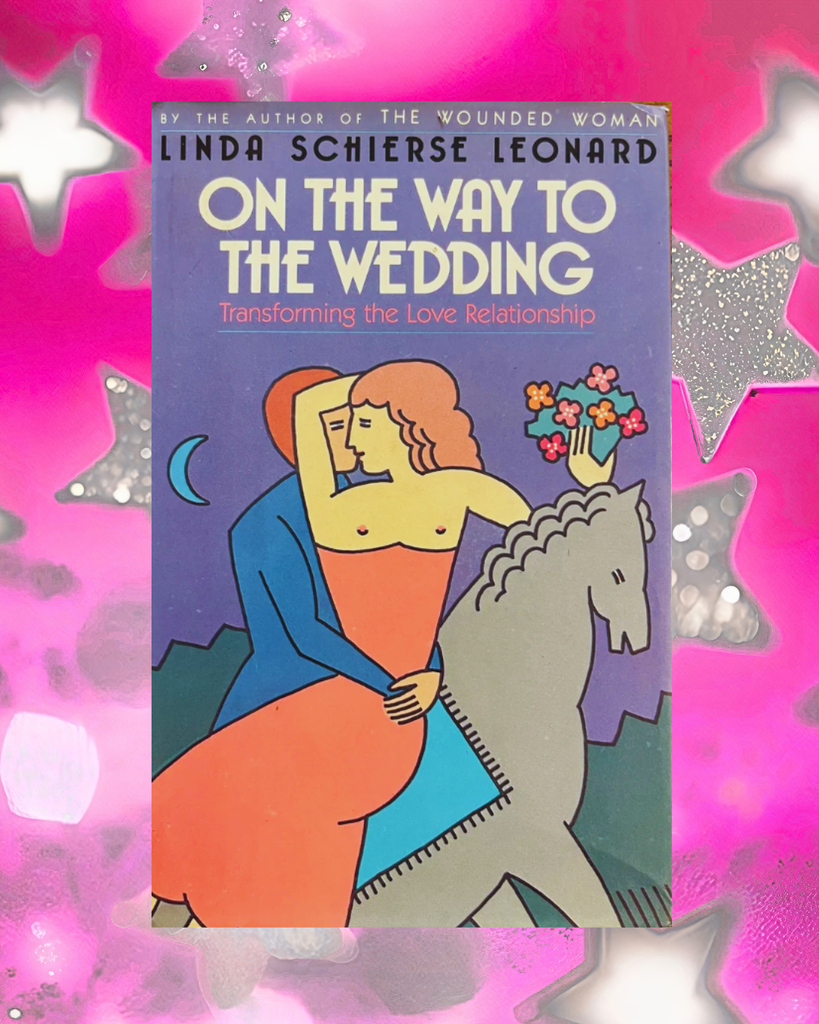
This is also what has brought me back to Linda Schierse Leonard’s On the Way to the Wedding: Transforming the Love Relationship. I read the book long before I imagined I might be preparing for a wedding of my own. At the time, I was interested in its exploration of love, relationships, and the inner work involved in becoming part of a partnership. But I was reading it from a different place in my life.
I find myself curious about what will stand out to me this time. The book approaches love and marriage through a Jungian lens, considering not only the search for a partner, but also the inner journey that accompanies it. Leonard describes three stages: the search for a love relationship, the coming together of lovers, and the wedding as an affirmation and synthesis of the experiences that have brought two people to that point. Drawing on her own life, her work as an analyst, fairy tales, legends, literature, film, dream, and mythology, she explores the ways our ideas about love are influenced by desire, family, culture, and the search for meaning.
I suspect that returning to these ideas now will be a different experience altogether. The words haven’t changed, but I have. And that’s one of the more interesting things about revisiting a book: sometimes what we discover on the second reading has less to do with what the author wrote and more to do with everything we’ve lived since we first opened its pages.
On the Way to Becoming will be a place for those reflections.
I’ll be revisiting memories from my years as a wedding makeup artist, along with photographs, objects, conversations, and experiences that have taken on new meaning with time. Some of these stories are about weddings and the people who invited me into their lives. Others are about my own family, relationships, expectations, and the things we carry with us without always realizing it. I’ll be looking at them through the lens of psychology, with beauty as a recurring thread.
And by beauty, I mean more than the application of makeup or the pursuit of a particular appearance. I’m interested in beauty as a way of seeing: how we perceive ourselves, how we recognize one another, what draws our attention, and how our understanding of something can change as we do. I’ve always been fascinated by the relationship between the person looking in the mirror and the person looking back.
That’s part of what makes this subject feel so connected to my work. The makeup chair, the mirror, the compact, and the wedding day all offer opportunities to consider the relationship between appearance and identity. They invite us to ask not only how we want to be seen, but how well we see ourselves.
I spent fifteen years helping women prepare to be seen on their wedding day. Now I’m increasingly interested in what it means to truly see ourselves, and one another, over the course of a life.
You don’t have to be engaged, married, or even interested in getting married to come along. These are questions about becoming, and becoming is something we continue to do regardless of our relationship status. We all arrive at our relationships carrying something: family histories, old ideas, expectations, disappointments, hopes, and versions of ourselves we may eventually outgrow.
I’m beginning this series with marriage, but I suspect we’ll find ourselves exploring much more than that.
After all, the wedding is a day. Becoming is a lifelong undertaking.
I’m looking forward to exploring what we discover along the way.